Am Kaiserstrand Bathhouse
Designed by Lang+Schwaerzler, this bathhouse is located in Lochau, Austria. 2010


- This bathhouse sits on top of a platform, which is supported by 30 concrete columns.
- It provides the necessities of changing rooms, showers, toilets.
- It also provides a restaurant, which the walls are replaced by windows to open up the space and create an illusion of being afloat in the sea while dining. There is also the option of dining outside on the terrace.
- The outer layer of the bathhouse is made up of high-folding shutters, which can either be opened up or closed, depending on various conditions such as the weather.
- Temperature is taken into account when designing this bathhouse; it is equipped with controlled ventilation and heat recovery. In warmer temperatures, the bathhouse uses incoming air via an air-to-air heat pump to maintain the inside temperature.
- A consistent theme running in this bathhouse is the material use of silver fir wood, sustainably collected from a nearby forest. This particular wood will weather naturally over time.
I appreciate the sustainability incorporated in this design, through the use of wood and the consideration of temperature. I especially love the direct connection from the bathhouse onto the beach, and how the materials make the transition more “natural” as opposed to using “modern” materials such as concrete or untextured stone.
Bath and Storage Pavilion
Designed by brro arquitetos, located in Santo Antonio de Posse, Brazil. 2018


- It is located next to a dam, which has naturally formed a beach. Because of this, this structure was created, providing a changing room, a toilet, and a shower.
- The sun is heavily involved with the design of this pavilion, where it leaks through the gaps of the wooden boards, and creates lined shadows on the concrete floor.
- “The hollowed element allows natural ventilation and illumination, besides allowing visibility, bringing the surrounding nature colors to the interior.”
- Materials used were concrete, and garapeira wooden boards which are framed by metal structures.
I appreciate the simplicity of this design, yet its effectiveness, both during the day and night. The main use of wood does not interfere with the surrounding nature of the pavilion, and the use of concrete does not stand out as much, as it is only really visible as the roof, and in the interior of the space. I also find it interesting that although there are gaps in the wooden boards, it can conceal the view when standing at a certain angle. I find that this is almost an oxymoron in itself, that the gaps open up the space, yet it does not reveal everything.
Returning Hut Residence
Designed by Xu Fu-Min, located in Fujian Province, outisde the city of Xiamen, China. 2016


- A simple, elegant, and natural interior design which helps residents retreat from the city to fully embrace in tranquility and the peace of the environment.
- The building is two-storeys, placed between a forest and a mountain.
- “It reflects the essence of space and materials, and presents a space where nature coexists with human” – Xu.
- Materials predominantly used are wood, stone, tiles, and glass. Most of these materials are a reflection of the surrounding area, bringing the texture and appearance of the environment into the building.
- The furnishings are kept simple and consistent: most of the furniture is made out of wood, and the colour palette is muted.
Although this is designed with the purpose of residence, the concept and morals are aligned with my own concept: To design a place which appreciates the surrounding nature and enjoy a quiet and leisurely life, while also using natural materials, but also incorporating the nature by allowing its terrain to become a part of the residence.
Horai Onsen Bathhouse
Designed by Kengo Kuma & Associates, located in Izusan, Atami-shi, Shizuoka, Japan. 2003


- An extension of an existing public bathhouse (Hoshino Resorts). It is an outdoor bath with a transparent roof. It is located on a large slope which overlooks the Pacific Ocean.
- The design of this bathhouse is linear: #1 you enter the bathhouse -> #2 you take off your clothes -> #3 you enter the washing area -> #4 then enter the spa area. (note that #4 is the focus of this research, it is the photos provided below).
- Materials used were Japanese cypress boards, light corrugated plastic for the roof, and steel bars for roof support. The correlation of the transparent roof and the cypress wood were used “in order to recreate the tradition of wooden structures in Japan in a contemporary manner.” – Kengo Kuma & Associates.


The Therme Vals
Designed by Peter Zumthor, with Marc Loeliger, Thomas Durisch and Rainer Weitschies. It is located in the Graubunden Canton, Switzerland. 1996

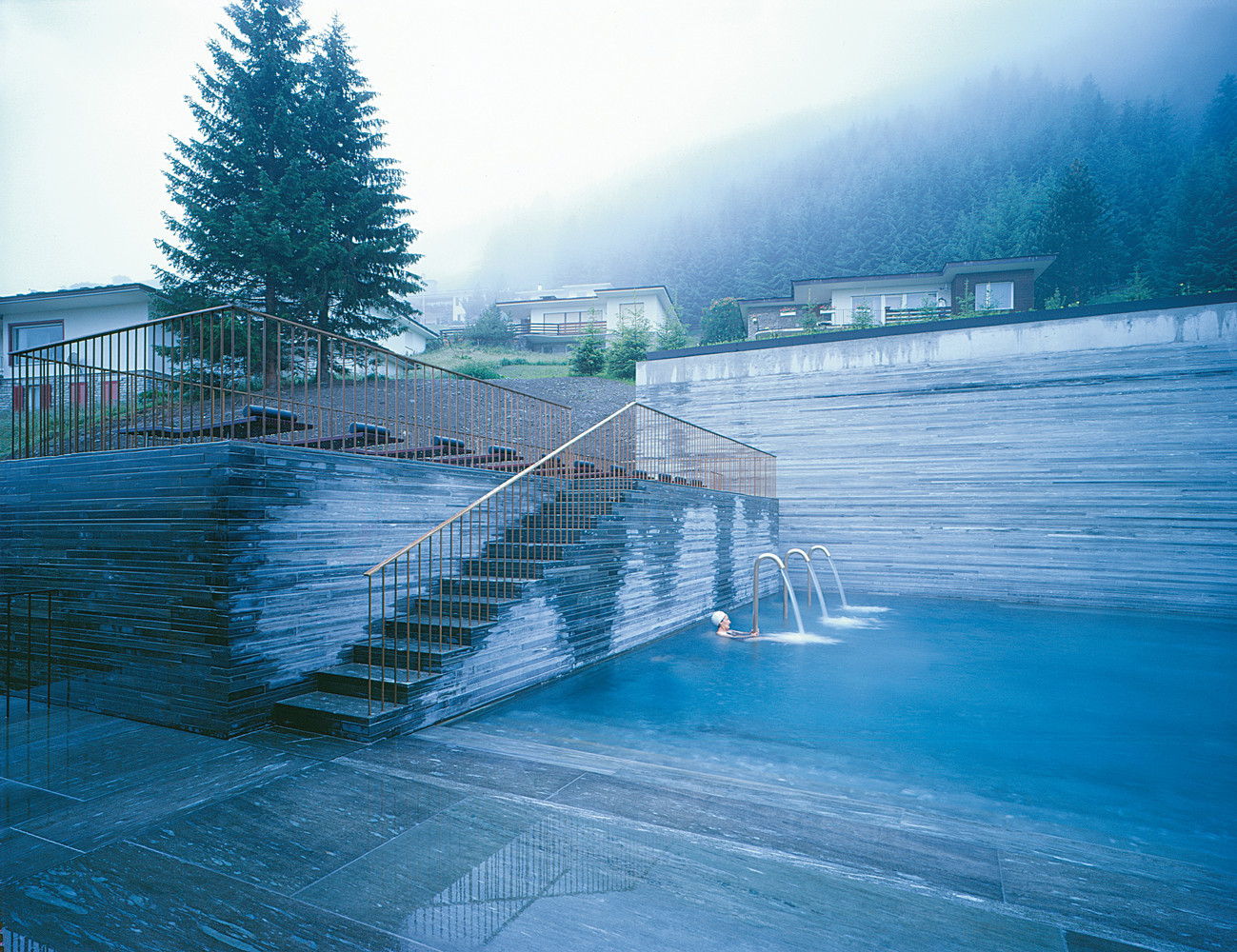


- An extension of the 7132 Hotel Vals.
- The inspiration of the spa was based on caves and quarries, hence the use of stone in the design.
- “Mountain, stone, water – building in the stone, building with the stone, into the mountain, building out of the mountain, being inside the mountain – how can the implications and the sensuality of the association of these words be interpreted, architecturally?” Peter Zumthor.
- Created for a sensory experience, and to “relive” the luxury of ancient benefits of bathing; bringing back the history of bathing.
- The layout of the bath encourages visitors to discover and move through the space, where different areas have a variation of light sources (some spots are well lit, while others depend on the light under the water as the main light source). There is also the option of bathing in the open area, where you notice that the spa is surrounded by the forest.
- Materials used were mainly Valser Quarzite slabs, present in both the interior and exterior walls. It is also used as the flooring.
The contrast between the surroundings of the bathhouse (the forest) and the bathhouse itself (made out of slabs) was initially something I did not think would work very well together, as I thought the two were very different. However, I noticed that this in fact makes the bathhouse stand out more, and that the cool tones of the material do not interfere with the colours of the forest, which also has similar tones. I also like how the style of this bathhouse is fairly straightforward, where the walls are smoothed down, and the overall shape of the bathhouse is square blocks.

 AUT Spatial Design
1 Comment